
Inclusive Practices
Teaching inclusively is much more than just meeting accommodations - it’s about meeting students as they are. Standards 2, 8, and 9 remind me that effective instruction is flexible, student-responsive, and rooted in ongoing reflection.
Standard 2 pushes me to design with learners in mind (from the very beginning) by accounting for different strengths, needs, and lived experiences. Standard 8 challenges me to use a variety of instructional strategies that give all students ways to engage, express, and succeed. And Standard 9 asks me to reflect on my own practice, to stay open to feedback, and to keep learning how to serve students more ethically and effectively.
Together, these standards shape how I think about equity in real, tangible terms. Inclusive teaching means adapting, reflecting, and constantly asking: Who is this lesson built for? Who might still be on the outside of it? And what can I do about that?

Student Choice
When we returned from spring break, I knew my students would need a full day to revisit Maus I before we could dive into Maus II. Up to that point, traditional review worksheets had worked well for the class - but I knew a weeklong break could change things. I needed to meet my students where they were, and I knew they’d be coming back with very different levels of retention and access.
I know some of my students don't have internet at home. Others went on vacation and left their materials behind. A few kept up and even read ahead, bringing copies with them. After reflecting on these differences, I decided to ditch the one-size-fits-all review and design a Maus Review Bingo instead. This format gave students a choice of tasks that reviewed key content and themes, while also giving them multiple pathways to demonstrate understanding. Whether they preferred writing, drawing, or more creative options, each student had an entry point that worked for them.
This activity reflects Standard 2 by honoring learning differences and providing differentiated ways for students to re-engage with the material. It was about more than just review - it was about making sure every student, regardless of how their break went, felt like they had a way back into the work and a foundation to succeed moving forward.
Variety
While the 2hr 40min “humanities” block is usually split evenly between ELA and US History, there are days that require flexibility. One morning, I found out that the US History co-teacher would be out covering another class, and I would have the entire block for ELA. Rather than just pushing ahead with the following day’s agenda and seeing how far we could get, I knew I had to think differently. Teaching a 160-minute block is not the same as teaching two 80-minute ones. Sustaining attention, engagement, and energy for that long requires real planning and variety.
This artifact shows how I intentionally built a sequence of varied instructional strategies to support focus, movement, and learning across nearly three hours. We started with a bell ringer of student choice - some opted for “opinions,” while most chose “mistakes.” From there, the day included a mix of teacher-led reading, whole-class discussion, small group Padlet responses and share-outs, a built-in break, randomized group formation using a wheel spinner, independent reading, and finally, partner responses using chart paper around the room.
By shifting modes throughout the block in writing, speaking, moving, discussing, and reflecting, I was able to keep students engaged while meeting a range of learning preferences. This aligns directly with Standard 8, which emphasizes using a variety of instructional strategies to help all students learn effectively. It also touches Standard 2, as I made adjustments on the fly to support different needs, energies, and working styles within a long and unexpected instructional window.

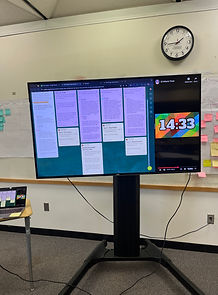


try to spot me!
Professional Development
At my second placement, I had the opportunity to attend an average of two meetings a week, with one often being professional development. This gave me rich insight into what it means to be an educator beyond the classroom. One of the most impactful sessions I participated in challenged me to rethink what inclusive practice really looks like - especially outside the typical boundaries of instruction.
The biggest eye-opener for me was the role of the cafeteria. It’s easy as a teacher to label that space as “theirs” and opt not to intervene - seeing it as a place where students can unwind and where we shouldn’t “bother” them. But what I learned is that the cafeteria is often a space where social segregation happens most visibly. Who sits with whom, who gets excluded, and who feels like they don’t belong - it all plays out in ways that deeply affect school climate and student experience.
This session pushed me to see my role as an inclusive practitioner not just in my classroom, but throughout the school. I started making intentional efforts to be present in non-academic spaces, not necessarily to monitor, but to support, connect, and build relationships. Inclusion doesn’t turn off when the bell rings. Whether or not I’m “in charge” of a space, I have a responsibility to create community wherever I am.
This experience reflects Standard 9 by showing how professional development helped me expand my thinking and take ethical action in support of all students. It reminded me that my influence isn’t limited to the content I teach, but it’s also in the way I show up, the spaces I enter, and the systems I help shape.
Standard #1: Learner Development
The teacher understands how learners grow and develop, recognizing that patterns of learning and development vary individually within and across the cognitive, linguistic, social, emotional, and physical areas, and designs and implements developmentally appropriate and challenging learning experiences.
Standard #2: Learning Differences
The teacher uses understanding of individual differences and diverse cultures and communities to ensure inclusive learning environments that enable each learner to meet high standards.
Standard #3: Learning Environments
The teacher works with others to create environments that support individual and collaborative learning, and that encourage positive social interaction, active engagement in learning, and self motivation.
Standard #4: Content Knowledge
The teacher understands the central concepts, tools of inquiry, and structures of the discipline(s) they teach and create learning experiences that make these aspects of the discipline accessible and meaningful for learners to assure mastery of the content.
Standard #5: Application of Content
The teacher understands how to connect concepts and use differing perspectives to engage learners in critical thinking, creativity, and collaborative problem solving related to authentic local and global issues.
Standard #6: Assessment
The teacher understands and uses multiple methods of assessment to engage learners in their own growth, to monitor learner progress, and to guide the teacher’s and learner’s decision making.
Standard #7: Planning for Instruction
The teacher plans instruction that supports every student in meeting rigorous learning goals by drawing upon knowledge of content areas, curriculum, cross- disciplinary skills, and pedagogy, as well as knowledge of learners and the community context.
Standard #8: Instructional Strategies
The teacher understands and uses a variety of instructional strategies to encourage learners to develop deep understanding of content areas and their connections, and to build skills to apply knowledge in meaningful ways.
Standard #9: Professional Learning and Ethical Practice
The teacher engages in ongoing professional learning and uses evidence to continually evaluate their practice, particularly the effects of their choices and actions on others (learners, families, other professionals, and the community), and adapts practice to meet the needs of each learner.
Standard #10: Leadership and Collaboration
The teacher seeks appropriate leadership roles and opportunities to take responsibility for student learning, to collaborate with learners, families, colleagues, other school professionals, and community members to ensure learner growth, and to advance the profession.